|
The Dynasty of Kamehameha
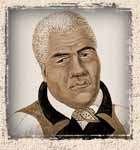
King Kamehameha I |
Kamehameha I,
Kamehameha the Great (1758-1819)
Born in North Kohala on the Big Island, Kamehameha united
all the major islands under one rule in 1810. The king
continued to trade with foreign ships arriving in the
islands and enlisted some of the foreigners into his
service. During his reign, the export of sandalwood to the
Orient brought about the ability for island chiefs to
purchase merchandise from abroad. Kamehameha successfully
defended the islands against invading Russian forces in
1816 and 1817.
|
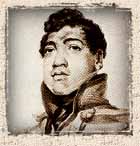
Kamehameha II,
Liholiho |
Kamehameha
II, Liholiho (1796-1824)
The son of Kamehameha and his sacred wife Keopuolani,
Liholiho overthrew the ancient kapu system by allowing men
and women of the court to eat at the same table. At the same
time, he announced that the heiau (temples) should be
destroyed with all the old idols. Chiefs continued to
prosper in the trade of sandalwood, whaling began in the
islands and missionaries came to spread Christianity.
Believing like his father that the islands were under the
protection of Great Britain, Liholiho and his favorite wife
Kamamalu traveled to England in May of 1824, where they were
received by the government of King George IV. However,
measles afflicted the royal party and Kamamalu died on July
8 followed by Liholiho on July 14.
|
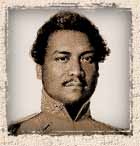
Kamehameha III,
Kauikeaouli |
Kamehameha
III, Kauikeaouli (1813-1854)
The younger brother of Liholiho had the longest reign in Hawaiian
history. He was 10 years old when he was proclaimed king in 1825 under
a regency with Kaahumanu, his father's
favorite queen, as kuhina nui or joint ruler. She was later
succeeded by Kinau, the king's half-sister. Realizing the
need for written laws to control growing problems brought
about by increasing numbers of foreigners settling in the
kingdom, the council of chiefs employed William Richards to
teach them political science. The declaration of rights,
called the Hawaiian Magna Charta, was issued on June 7,
1839. Persecution of Catholics stopped when the king issued
an oral "edict of toleration" the same month. The
rights of residents were repeated in the Constitution of
1840. The Great Mahele (division), the first legal basis for
land ownership in the kingdom, was enacted and divided the
land between the king and his chiefs. Sandalwood trading and
whaling declined during this time, but the sugar industry
began to grow. Churches and schools were built. |
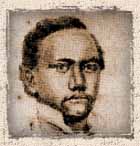
Kamehameha IV,
Alexander Liholiho |
Kamehameha
IV, Alexander Liholiho (1834-1863)
The nephew of Kauikeaouli, Alexander Liholiho was the son of
Kekuanaoa and his wife Kinau, the grandson of Kamehameha I,
younger brother of Lot Kamehameha and elder brother of
Victoria Kamamalu. He ascended to the throne after the death
of his uncle in December of 1854. On June 19, 1856, he
married Emma Rooke, who had been adopted by her aunt and
English doctor T.C. B. Rooke. They would have a son, Albert,
but he would eventually succumb to meningitis at the age of
four. Concerned about the toll that foreign diseases were
taking on his subjects, the king signed a law on April 20,
1859 that established a hospital in Honolulu for sick and
destitute Hawaiians. He and Emma personally solicited funds
to erect Queen's Hospital, which was named in honor of Emma.
The king also established the Anglican Church of Hawaii.
Fluent in both English and Hawaiian, he translated the
English Book of Common Prayer to his native language.
Weakened by his chronic bouts with asthma and the death of
his son in August of 1862, the king passed away on November
30, 1863, at the age of 29 and after a reign of only nine
years.
|
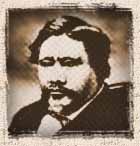
Kamehameha V,
Lot Kapuaiwa |
Kamehameha
V, Lot Kapuaiwa Kamehameha (1830-1872)
Four years older than his brother Kamehameha IV, Lot would
also rule for just nine years. Like his brother, he was
educated at Royal School and had the opportunity to travel
to Paris, London and the United States. He believed the
example of his grandfather, Kamehameha I, gave him the right
to lead the Hawaiian people, and he favored a stronger
monarchy that bordered on despotism. Wanting to protect his
people from waste and idleness, he defeated a proposal to
repeal the law against selling strong liquor to Hawaiians,
saying: "I will never sign the death warrant of my
people." He tried to restrict hula dances and parties
that would keep workers from their crops. In 1864, when it
appeared that a new constitution could not be agreed upon,
he declared that the Constitution of 1852 be replaced by one
he had written himself, one that freed the king from control
of the privy council and the kuhina nui and limited the
privilege of voting. Known as "the bachelor king,"
Lot Kamehameha did not name a successor, which led to the
invoking of the constitutional provision for electing kings
of Hawaii.
|
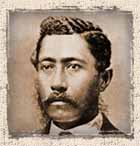
William Charles
Lunalilo |
William
Charles Lunalilo (1833-1874)
The grandson of a half-brother of Kamehameha I, Lunalilo was
the son of Charles Kanaina and Kekauluohi, a sister of Kinau.
He defeated David Kalakaua in 1873 to become the first king
to be elected. He offered many amendments to the
Constitution of 1864, such as abolishing the property
qualifications for voting. During his reign, the Household
Troops staged a Sunday mutiny, rebelling against their
officers and remaining in their barracks until a carefully
worded message from the king persuaded them to lay down
their arms six days later. The king them disbanded the
troops. Lunalilo died of tuberculosis on February 3, 1874, a
little more than a year after his election. He became the
first Hawaiian to leave his property to a work of charity.
His will created the Lunalilo Home, which accommodates
elderly Hawaiians who are poor, destitute and infirm.
|
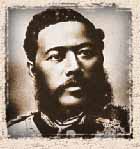
David Kalakaua |
David
Kalakaua (1836-1891)
Kalakaua was born in Honolulu at the foot of Punchbowl
Crater and educated at the Royal School. He married
Kapiolani in 1863. He was a candidate for the crown in 1872,
after the death of Kamehameha V, but was badly defeated by
Lunalilo in the islands' first-ever election of a king.
After the death of Lunalilo, Kalakaua ran against the queen
dowager, Emma, widow of Kamehameha IV. Legislators gave Emma
only six of the 45 votes, and the courthouse became the
scene of a bloody riot by Emma's supporters. Armed American
and British marines were required to quell the disturbance.
Kalakaua was the first king in history to visit the United
States, and in 1881 set out on a world tour to visit other
heads of state. "The Merry Monarch" was fond of
old Hawaiian customs, and he attempted to restore the
people's lost heritage. But the latter half of his reign was
marred by corruption, including land deals benefiting his
poker player friend Claus Spreckels, repeal of the laws
against furnishing Hawaiians with liquor, a lottery,
licensing of the sale of opium and revival of the ancient
kahuna's role. Such actions gave rise to anti-monarchy
movements, such as the Reform Party. In 1887, Kalakaua
signed the "Bayonet Constitution," so named
because it was signed under threat of an armed uprising. The
constitution stripped the king of most of his power and
permitted foreigners the right to vote provided they took an
oath to support the constitution. Kalakaua died while on a
trip to San Francisco on January 20, 1891, leaving his
younger sister Liliuokalani to ascend the throne.
|
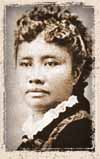
Queen Liliuokalani |
Queen
Lydia Kamakaeha Kaolamalii Liliuokalani (1839-1917)
Born in Honolulu, Liliuokalani was one of seven children
born to Kapaakea and his wife Keohokalole. She was two years
younger than her brother Kalakaua. She married John Owen
Dominis in 1862, shortly before he was made governor of
Oahu. They lived at his mother's home, Washington Place.
After Kalakaua died, she was proclaimed queen. Her husband
died seven months into her reign. Liliuokalani had a strong
desire to restore the old authority of the crown that had
been signed away in the "Bayonet Constitution" of
1887. Her efforts to overthrow the constitution that she was
supposed to maintain as queen was only one of the
complicated causes of the overthrow of the monarchy. She was
deposed on January 17, 1893, signing a formal abdication and
pledging her allegiance to the Republic of Hawaii. In 1911,
she attended the opening of the Pearl Harbor Naval Base,
where she was seated with her successor Sanford B. Dole.
When the United States entered World War I, she flew the
Stars and Stripes over Washington Place for the first time.
The queen authored a number of songs, the best known of
which is "Aloha Oe." The words to the song are
preserved on a bronze plaque set in a lava boulder at
Washington Place. |
|
City of Refuge; Kona, Hawaii
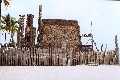
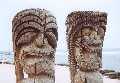
When
one speaks of ancient Hawaiian culture, one of the first things to
come to mind may be the "Kapu" system. The social order
of old Hawaii was defined by very strict societal rules, do's and
don'ts, and the transgressor paid with his or her life. Every
crime was a capital offense, steppng onto the chief's shadow,
fishing out of season, were indeed paid for with one's life.
Acquital was possible if he or she could reach a pu'uhonua (place
of refuge) and be cleansed as well as exonerarated by a kahuna
(priest). The pu'uhonua was especially important in times of war
as a refuge for women and children as well as warriors from the
defeated side.
|
|

|
Hawaii Statehood
1959
|
|

48 Stars
|

49 Stars
|

50 Stars
|
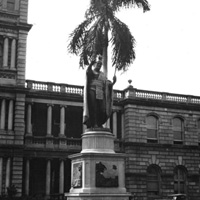
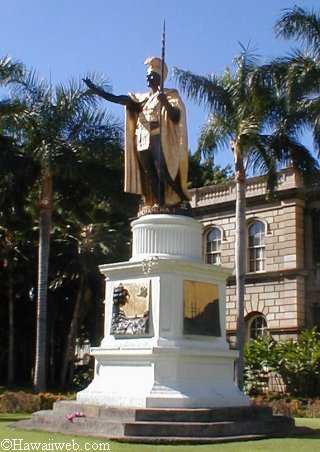
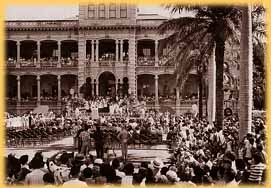
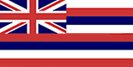
Kamehameha Statue in front of Iolani Palace
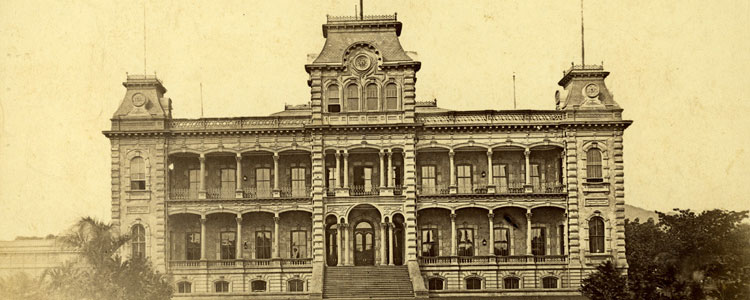
Iolani Palace 1882

Iolani Palace 1966
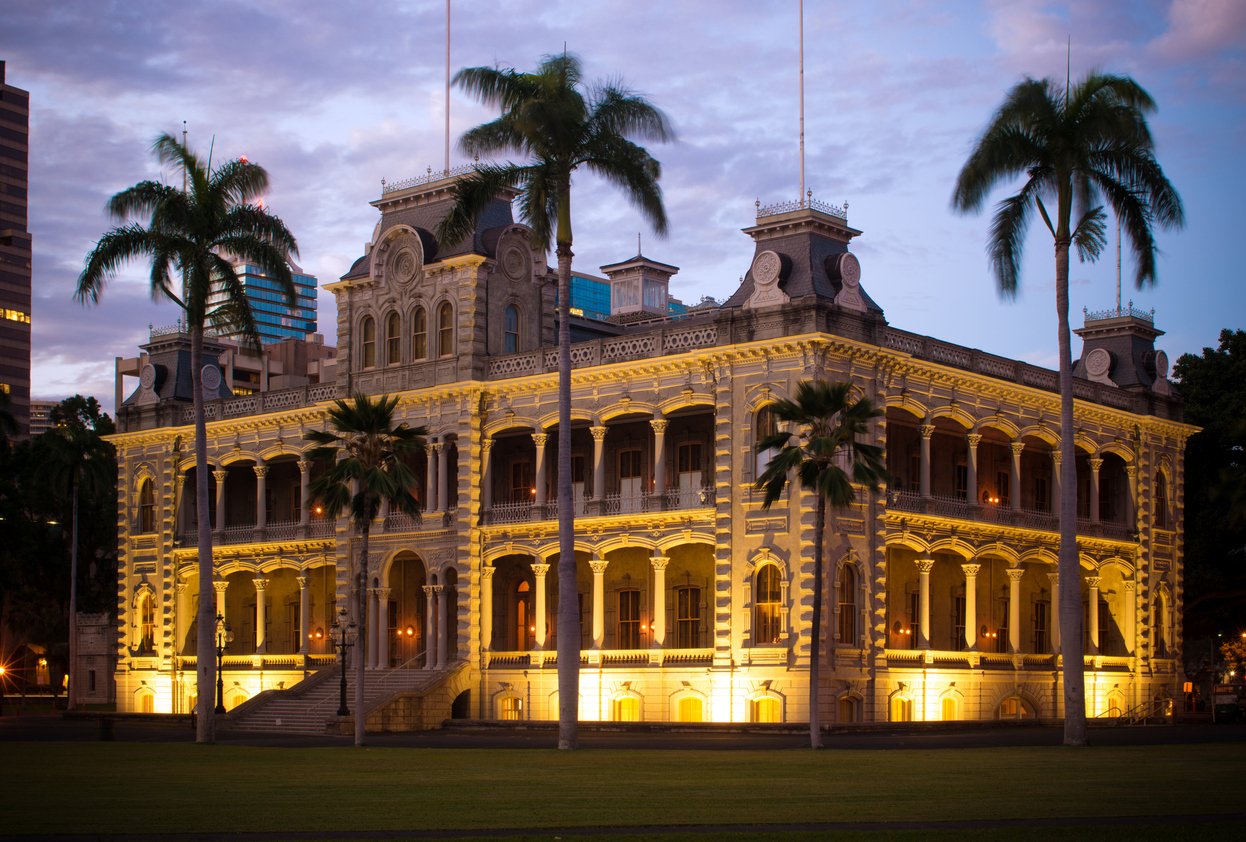
Iolani Palace Today
(click on image for larger viewing)


|